
Understanding the computer keyboard is fundamental for efficient digital interaction; this guide explores keys and their diverse functions, aiding productivity.
The keyboard serves as a primary input device, translating human commands into a language computers understand, enabling seamless operation across applications.
Mastering keyboard functions unlocks a world of shortcuts and streamlined workflows, boosting efficiency in tasks ranging from simple typing to complex programming.
What is a Computer Keyboard?
A computer keyboard is a crucial input device, resembling a typewriter, used to enter text, characters, and commands into a computer system. It’s essentially a collection of buttons, or keys, each corresponding to a specific symbol or function. These keys, when pressed, send signals to the computer, instructing it to perform a designated action.
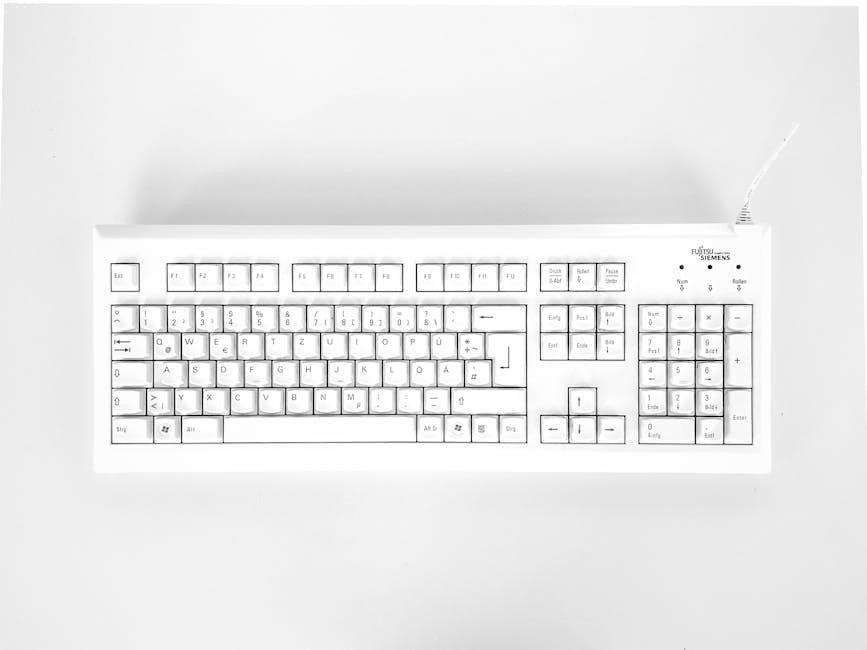
Modern keyboards typically follow the QWERTY layout, though variations exist. They connect to computers via wired (USB) or wireless (Bluetooth) connections. Beyond basic alphanumeric keys, keyboards include navigation keys (arrow keys, Page Up/Down), function keys (F1-F12), and special keys like Shift, Ctrl, and Alt, enhancing functionality.
The keyboard’s role extends beyond simple text input; it’s integral to controlling software, navigating interfaces, and executing commands, making it an indispensable tool for virtually all computer users. Understanding its components is key to maximizing computer proficiency.
Importance of Understanding Keyboard Functions
Proficiency with keyboard functions dramatically enhances computer usability and productivity. Knowing shortcuts and key combinations reduces reliance on mouse actions, accelerating workflows and minimizing repetitive strain. Mastering these functions isn’t just about speed; it’s about efficiency and control.
Understanding special key combinations – like Ctrl+C for copy or Ctrl+V for paste – streamlines common tasks. Familiarity with navigation keys (arrow keys, Page Up/Down) allows for swift document and web page traversal. Function keys (F1-F12) offer application-specific commands, further optimizing performance.
Ultimately, a solid grasp of keyboard functions empowers users to interact with computers more effectively, unlocking advanced features and maximizing their digital capabilities. It’s a foundational skill for anyone seeking to become a confident and capable computer user.
Basic Keyboard Keys and Their Functions
Essential keys – alphanumeric, spacebar, and Enter – form the foundation of text input and command execution, enabling fundamental computer interactions.
Alphanumeric Keys
Alphanumeric keys comprise the core of any computer keyboard, encompassing letters (A-Z) and numbers (0-9). These keys are primarily utilized for inputting text, creating documents, writing code, and entering numerical data into various applications. Their arrangement generally follows a QWERTY layout, though alternative layouts like DVORAK exist, optimized for efficiency.
Each key press translates into a specific character displayed on the screen. The functionality extends beyond simple character input; when combined with modifier keys like Shift, alphanumeric keys can produce uppercase letters, symbols, and alternate characters. Understanding the placement and function of these keys is paramount for basic computer literacy and efficient data entry. They are the building blocks of digital communication and content creation.
Spacebar Functionality
The spacebar, typically the longest key on the keyboard, serves a deceptively simple yet crucial function: inserting a blank space between words and characters. This seemingly minor action is fundamental to readability and clear communication in written text. Beyond basic word separation, the spacebar has diverse applications across software.
In many programs, a single press of the spacebar initiates an action – playing/pausing media, moving to the next slide in a presentation, or accepting a selection. Web browsers utilize it for scrolling down a page. Its versatility extends to gaming, where it often controls jumps or other actions; Mastering the spacebar’s varied uses significantly enhances user experience and productivity across numerous digital platforms.
Enter/Return Key – Usage and Purpose
The Enter/Return key, often labeled simply “Enter,” performs multiple vital functions depending on the software in use. Primarily, it confirms input and initiates commands. In text editors and word processors, pressing Enter creates a new paragraph or line break, structuring written content. Within dialog boxes and forms, it typically submits the entered information, completing an action like logging in or saving settings.
Beyond text manipulation, the Enter key often triggers actions within applications. For example, it might execute a command in a coding environment or confirm a selection in a menu. Its dual functionality – line break creation and command execution – makes it an indispensable key for efficient computer operation and data input across diverse digital environments.

Navigation Keys
Navigation keys facilitate movement within documents, web pages, and interfaces, enabling precise cursor control and efficient exploration of digital content.
Arrow Keys – Up, Down, Left, Right
Arrow keys are foundational navigation tools, enabling precise, directional movement within digital environments. The up and down keys typically scroll vertically through documents, web pages, or lists, allowing users to navigate content line by line. Conversely, the left and right arrow keys facilitate horizontal movement, useful for positioning the cursor within text or navigating columns in spreadsheets.
These keys are universally recognized across operating systems and applications, providing a consistent user experience. Beyond simple navigation, arrow keys are frequently used in gaming for character control and in graphical interfaces for selecting options. Their functionality extends to manipulating objects and adjusting parameters within software programs, making them indispensable for a wide range of tasks. Mastering arrow key usage significantly enhances computer interaction efficiency.
Page Up and Page Down Keys
Page Up and Page Down keys offer rapid vertical navigation, differing from the incremental movement provided by the arrow keys. These keys scroll through documents and web pages in larger increments – typically one screenful at a time. Pressing Page Up moves the view upwards, revealing the preceding content, while Page Down scrolls downwards, displaying subsequent sections.
This functionality is particularly beneficial when reviewing lengthy documents or web pages, allowing users to quickly jump between sections without tedious scrolling. They are commonly used in conjunction with arrow keys for more refined navigation. Beyond document viewing, these keys find application in spreadsheet software for navigating between worksheets and in certain applications for cycling through different views or panels. Efficient use of these keys dramatically improves browsing speed.
Home and End Keys
Home and End keys provide direct navigation to specific locations within a line of text or a document. The Home key instantly moves the cursor to the beginning of the current line, regardless of the cursor’s initial position. Conversely, the End key swiftly transports the cursor to the end of the line. This functionality is incredibly useful for making edits or selections at the start or finish of a line without manually positioning the cursor.
In documents spanning multiple pages, these keys often navigate to the beginning or end of the entire document, offering quick access to the first or last content. Combined with the Shift key, they facilitate rapid selection of text from the cursor’s current position to the beginning or end of the line or document, enhancing editing efficiency.
Special Keys and Their Combinations
Special keys, like Tab, Shift, Ctrl, and Alt, modify standard input, creating powerful shortcuts and alternative commands for enhanced control.

Tab Key – Functionality and Applications
The Tab key is a versatile tool with numerous applications across various software programs. Primarily, it introduces indentation, crucial for formatting text documents and code, creating structured outlines and readable content. In word processors like Microsoft Word, pressing Tab creates a standard indent, replacing multiple spaces for consistent formatting.
Beyond text formatting, the Tab key facilitates navigation within interfaces. It cycles through interactive elements like buttons, text fields, and menu options on web pages and within applications, offering an alternative to mouse clicks. This is particularly useful for accessibility and keyboard-centric workflows.
Furthermore, Tab is integral in spreadsheet software like Excel, moving selection to the next cell, enabling efficient data entry and manipulation. Its functionality extends to command-line interfaces, completing file and directory names, saving valuable typing time. Essentially, the Tab key streamlines interaction and enhances productivity across diverse computing tasks.
Shift Key – Modifying Input
The Shift key is a modifier key, fundamentally altering the output of other keys. Its most common function is capitalization, transforming lowercase letters into uppercase when pressed in conjunction with a letter key. However, its utility extends far beyond simple capitalization.
Shift enables access to alternate characters printed on number keys – for example, pressing Shift+1 typically yields the exclamation mark (!). This expands the range of readily available symbols without requiring dedicated keys. It also plays a crucial role in selecting text; holding Shift while using arrow keys extends the selection range.
Furthermore, Shift modifies the function of certain commands. In combination with Ctrl or Alt, it unlocks additional shortcuts and functionalities within applications. For instance, Shift+Click often initiates a different action than a standard click. Mastering the Shift key is essential for efficient and nuanced computer operation, enhancing input control and productivity.
Ctrl Key – Command Combinations
The Ctrl (Control) key is a powerful modifier, primarily used in conjunction with other keys to execute commands. It’s a cornerstone of keyboard shortcuts, dramatically increasing efficiency across various applications and operating systems.
Perhaps the most universally recognized Ctrl combinations are Ctrl+C (copy), Ctrl+V (paste), and Ctrl+X (cut). These commands are fundamental for text editing, file management, and data manipulation. Beyond these basics, Ctrl unlocks a vast array of application-specific shortcuts.
For example, Ctrl+S typically saves a file, while Ctrl+Z undoes the last action. In web browsers, Ctrl+T opens a new tab, and Ctrl+W closes the current one. The Ctrl key’s versatility makes it indispensable for power users, enabling rapid navigation and control without relying on mouse clicks or menu selections. Understanding these combinations significantly boosts productivity.

Alt Key – Alternative Functions
The Alt (Alternate) key, similar to Ctrl, functions as a modifier, altering the standard function of other keys. Historically, Alt key combinations provided access to menu options within applications, often displayed underlined letters indicating the accessible command.
While its role has evolved with graphical user interfaces, Alt remains crucial for various shortcuts. Alt+Tab allows quick switching between open windows, a highly efficient multitasking tool. Alt+F4 typically closes the current window or application.
Furthermore, the Alt key is frequently used in combination with numeric keypads for entering special characters or codes. Its functionality often varies depending on the specific program in use, offering application-specific alternative commands. Mastering Alt key combinations unlocks a deeper level of control and streamlines workflows, enhancing overall computer usability and productivity.

Function Keys (F1-F12)
Function keys, labeled F1 through F12, offer application-specific commands, providing quick access to common actions and features within programs.
F1 Key – Common Uses
The F1 key is universally recognized as the “Help” key, instantly launching the help menu within most applications and operating systems. Pressing F1 typically displays context-sensitive assistance, offering guidance related to the current screen or selected feature.
Beyond help functions, F1’s utility varies. In some programs, it might open a specific help topic or tutorial. Within BIOS settings, F1 often accesses the main help screen, providing explanations of available options. It’s a crucial key for troubleshooting and learning software functionalities.
Furthermore, F1 can initiate specific actions depending on the application. For example, in Microsoft Word, it launches the Word Help feature. Understanding its context-dependent nature is key to maximizing its usefulness.
F2 Key – Renaming and Editing
The F2 key boasts significant functionality centered around renaming and quick editing. In Windows File Explorer, pressing F2 while a file or folder is selected instantly allows you to rename it, streamlining file management.
Beyond file renaming, F2 serves as a direct editing tool within many applications. In Microsoft Excel, selecting a cell and pressing F2 switches the cell into edit mode, enabling direct value modification. Similarly, in some text editors, F2 can rename the current file.
Its versatility extends to BIOS settings, where F2 frequently grants access to the system setup utility, allowing hardware configuration adjustments. Recognizing this dual role – renaming files and enabling in-place editing – makes F2 a highly efficient key for various tasks.
F3 Key – Search Functionality
The F3 key is predominantly recognized for its search capabilities across various applications. Within Windows Explorer and many file management systems, pressing F3 initiates a file search, opening the search bar and positioning the cursor ready for input.
Microsoft Word leverages F3 for navigating through the document’s Find function; Pressing F3 repeatedly cycles through instances of the searched term, accelerating document review and editing. This is particularly useful for locating specific phrases or keywords within lengthy texts.
Furthermore, some browsers and operating systems utilize F3 for initiating a global search, scanning across multiple locations for the desired information. Understanding this consistent search function makes F3 a valuable shortcut for quick information retrieval.
F4 Key – Address Bar and Other Uses
The F4 key exhibits versatile functionality, most notably within web browsers and file explorers. In popular browsers like Chrome, Firefox, and Edge, pressing F4 directly highlights the address bar, allowing for quick URL entry or modification. This streamlines web navigation, saving valuable time.
Within Windows Explorer, F4 cycles through different folders and locations, providing a rapid method for navigating the file system. Repeated presses move you up the directory structure, offering an alternative to clicking through folders.
Additionally, in some applications like Microsoft Word, F4 offers shortcuts for document operations. It can be used to repeat the last command or access specific formatting options. Its application-specific uses vary, but its core function remains focused on efficient navigation and command repetition.
F5 Key – Refreshing and Restarting
The F5 key is universally recognized as the ‘refresh’ command across numerous applications and operating systems. In web browsers, pressing F5 instantly reloads the current webpage, displaying the latest version of the content. This is invaluable for checking for updates or resolving display issues.
Within Windows Explorer, F5 performs a refresh of the current folder view, ensuring that any recent file changes are reflected. This eliminates the need to manually close and reopen the window to see updated content.
Furthermore, F5 often initiates a restart function within presentation software like PowerPoint, returning the presentation to the first slide. Its consistent function across platforms makes it a crucial key for maintaining up-to-date information and controlling application states.
F6-F12 Keys – Application-Specific Functions
While F1-F5 have relatively standardized functions, the keys F6 through F12 largely operate within the context of the currently active application. Their functionalities are highly variable and tailored to enhance workflow within specific programs.
In many web browsers, F6 typically highlights the address bar, allowing for quick URL editing. Within Microsoft Word, these keys often relate to spellcheck, window arrangement, and accessing help features. Excel utilizes them for navigating worksheets and initiating specific commands.
Gaming applications frequently remap these keys to perform in-game actions, providing players with customizable control schemes. Understanding these application-specific assignments requires exploring the program’s help documentation or settings menu to unlock their full potential.

Other Important Keys
Beyond the core functionalities, several keys offer crucial control, including Escape for cancellation, Caps Lock for case toggling, and Scroll Lock’s limited use.
Esc Key – Cancelling Operations
The Escape (Esc) key is a universal command for immediate cessation of current processes. Its primary function is to gracefully exit ongoing operations, preventing unintended actions or completed tasks. When a program is loading, a dialog box appears, or a webpage is rendering, pressing Esc typically halts the process.
In web browsers, Esc often stops page loading or closes full-screen modes. Within applications, it can dismiss menus, close dialogs, or cancel selections. It’s a vital tool for correcting mistakes or abandoning unwanted actions before they finalize. The Esc key provides a quick and easy way to revert to a previous state, offering a safety net during computer use. It’s a fundamental key for maintaining control and preventing frustrating errors.
Caps Lock Key – Toggle Case
The Caps Lock key functions as a toggle, switching between uppercase and lowercase letter input. When activated, all alphabetical characters typed will appear in uppercase; pressing it again returns to lowercase. It doesn’t affect numbers, symbols, or already capitalized letters within a word.
Historically, Caps Lock was designed to facilitate typing in all caps, common in early computing for emphasis or specific formatting. Today, its usage is less frequent, often employed for accidental capitalization or intentionally creating acronyms. Many users inadvertently activate Caps Lock, leading to unexpected uppercase text. It’s a simple yet sometimes troublesome key, requiring conscious awareness to avoid unintended results during typing.
Num Lock Key – Numeric Keypad Activation
The Num Lock key controls the functionality of the numeric keypad, typically located on the right side of full-sized keyboards. When Num Lock is activated, the keypad functions as a calculator, allowing direct number input. Deactivating Num Lock transforms the keypad into navigation keys – arrow keys, Home, End, Page Up, and Page Down – offering alternative cursor control.
The indicator light on the keyboard visually confirms the Num Lock status. Its purpose is to prevent accidental number entry when navigating documents or spreadsheets. Some laptops lack a dedicated numeric keypad, utilizing function key combinations to emulate one, where Num Lock still applies to those emulated keys. Understanding Num Lock is crucial for efficient data entry and navigation.
Scroll Lock Key – Rarely Used Functionality
Historically, the Scroll Lock key was intended to modify the behavior of the arrow keys, shifting scrolling functionality from cursor movement to page scrolling. However, its use has drastically diminished with the advent of modern operating systems and mouse-driven interfaces. Today, Scroll Lock has limited functionality in most applications, often remaining inactive or repurposed for specific program commands.
While some spreadsheet programs, like Microsoft Excel, still utilize Scroll Lock to switch between relative and absolute referencing during formula editing, this is a niche application. The key’s indicator light often serves as a visual reminder of its status, though its practical impact is minimal for most users. It’s largely considered a legacy key with dwindling relevance in contemporary computing.

Keyboard Shortcuts and Productivity
Leveraging keyboard shortcuts—like Ctrl+C, Ctrl+V, and Ctrl+X—significantly boosts efficiency, streamlining workflows across various applications and enhancing user speed.
Common Keyboard Shortcuts (Ctrl+C, Ctrl+V, Ctrl+X)

Essential for daily computer use, Ctrl+C (Copy), Ctrl+V (Paste), and Ctrl+X (Cut) are fundamental keyboard shortcuts that dramatically improve workflow efficiency. Ctrl+C duplicates selected content – text, images, files – to the clipboard, allowing for replication elsewhere. Subsequently, Ctrl+V inserts the copied content at the cursor’s location.
Ctrl+X, distinctively, removes the selected content from its original location while simultaneously copying it to the clipboard. This ‘cut’ action is ideal for moving content rather than duplicating it. These shortcuts transcend applications, functioning consistently across word processors, spreadsheets, web browsers, and more. Mastering these three commands alone can significantly reduce reliance on mouse-based actions, accelerating task completion and boosting overall productivity.
Application-Specific Shortcuts (Excel, Word, PowerPoint)
Beyond universal shortcuts, many applications boast unique keyboard combinations optimized for specific tasks. In Microsoft Excel, Ctrl+Shift+Enter performs array formulas, while Ctrl+Space selects an entire column. Microsoft Word utilizes Ctrl+Shift+C to copy formatting, and Ctrl+Shift+V to paste it without the underlying content.
PowerPoint benefits from shortcuts like Ctrl+D to duplicate a slide, and Shift+F5 initiates a presentation from the beginning. These application-specific shortcuts are designed to accelerate common actions within each program, reducing mouse clicks and streamlining workflows. Learning these tailored commands significantly enhances efficiency for frequent users, allowing for faster content creation and manipulation. Exploring each application’s help menu reveals a comprehensive list of available shortcuts.

Resources for Further Learning (PDF Guides)
To deepen your understanding of computer keyboard keys and their functions, numerous PDF guides are readily available online. Microsoft offers comprehensive documentation detailing keyboard shortcuts for all its Office applications, including Excel, Word, and PowerPoint. These guides often include visual aids and step-by-step instructions for mastering complex commands.
Several websites compile lists of keyboard shortcuts categorized by application and operating system. Searching for “keyboard shortcuts PDF” yields a wealth of resources, from beginner-friendly overviews to advanced cheat sheets. Additionally, many computer hardware manufacturers provide downloadable manuals outlining the specific functions of keys on their keyboards. Utilizing these PDF guides empowers users to unlock the full potential of their keyboard and enhance their digital proficiency.